|
|
|
 |
| Property Risk Control |
|
|
Commercial Property insurance, at times referred to as commercial fire and allied lines, is designed to cover insureds for direct and indirect losses related to commercial buildings, apartment structures, hotels, business personal property (e.g. building contents, furniture, equipment, fixtures, supplies, inventory etc.) loss of business income, builders' risks (buildings in the course of construction) and related exposures.
Direct losses refer to damage to the property itself resulting from an insured cause of loss such as fire, lightning, windstorm etc. Indirect losses, also known as time element losses, or consequential losses, refer to the loss of income, profit, or to the extra expense you might incur as a consequence of the direct loss.
Knowing what coverage and limits you need to purchase, in order to be sure that you are properly insured, requires very deliberate and careful consultation with your agent. However, to minimize loss and to help insure that your business survives a serious fire, windstorm or other such event, you must have an effective property risk control program in place.
To help you with your efforts to protecting business, property, and people, we will:
• Provide you with tips to help you identify and control some of the more common and
special hazards that pose a threat to many businesses; refer to
Hazard Identification and Control
• Provide you with some basic information on fire protection; refer to Fire Protection
• Provide eight Property Risk Control self help tools; refer to Appendices E
• Provide information regarding additional resources available through FCCI and elsewhere
that will present you with more detailed and in-depth information on many areas of Property
Risk Control, refer to Property - Additional Resource List (Appendix E10)
|
|
|
Hazard Identification and Control 
Flammable Liquids
Almost all businesses use flammable liquids. Examples include fuel for vehicles, cooking oil in a restaurant, cleaning solvents in an office building, paints in an automobile body shop and various chemicals used in manufacturing processes. To safeguard your business from flammable liquids you should have a basic understanding of the hazards they present and how to control them.
A flammable liquid is any liquid having a flash point below 100 degrees Fahrenheit. The flash point is the minimum temperature at which a liquid gives off a vapor in sufficient concentration to ignite. Flammable liquids are most hazardous when they are stored or used at temperatures approaching or exceeding their flash point. Given sufficient oxygen to support combustion and an ignition source, a fire can erupt and spread very quickly.
The major concern with flammable liquids is improper storage and handling. To protect your business, you will need to know:
• How to identify a flammable liquid
First, look at the container in which it was shipped to you. Labels on the outside of the
container usually provide information on flammability and reactivity. Also, review the
manufacturer's Material Safety Data Sheet (MSDS) for all chemicals you use or store. The
MSDS will detail physical hazards of the chemical such as fire, explosion. and reactivity as
well as precautions for safe handling, storage, and use of the chemical.
• The amount of flammable liquid used and how it is stored and handled
Basic requirements for storage are:
- No more than one day's supply should be kept outside a flammable liquids storage
cabinet or storage room
- Up to 25 gallons should be kept in Underwriters Laboratories (UL) listed safety cans
- From 25 gallons to 180 gallons should be kept in UL listed flammable liquids
storage cabinets
- No more than 60 gallons should be kept in a single cabinet
- No more than 3 cabinets (180 gallons) should be kept in a single building or fire area
- Over 180 gallons should be stored as per
Flammable Liquids Storage Room Requirements (Appendix E2)
There are many other areas to be concerned about if you have flammable liquids on your property including separation from sources of ignition, electrical wiring specifications, grounding and bonding, ventilation, drainage and spill control, maintenance, and repair.
Refer to:
• FCCI Risk Control Bulletin,
Safe Storage and Handling of Flammable and Combustibles Liquids (Appendix E1)
• Flammable Liquids Storage Room Requirements (Appendix E2)
• Bonding and Grounding of Flammable Liquid Containers (Appendix E3)
• NFPA 30* for more detailed information on flammable liquids
Combustible Gases
Combustible gases are substances in gaseous form, which can be ignited in the presence of air to cause a fire or an explosion. Examples include leaking compressed gas cylinders of acetylene and mishandled liquefied petroleum (LP) gas tanks. Acetylene has an extremely wide explosive range and pure acetylene under pressure will spontaneously explode. Compressed gas cylinders, especially acetylene, must be kept in a secured and in an upright position.
LP-Gas is used to fuel powered industrial trucks such as forklifts. LP-Gas vapors are heavier than air and tend to vaporize rapidly when they escape from containment vessels. Special precautions must be followed for safe operation of forklifts. Contact FCCI to request the Powered Industrial Truck Operator Training Program and/or refer to NFPA 505* for more information.
Although pure oxygen by itself does not burn, it supports combustion. If combustible material is present as the percentage of oxygen increases, you greatly increase the potential for a fire to occur. For example, leaking oxygen cylinders in the presence of a source of ignition can easily cause a fire. Gas fueled fires burn with faster than normal intensity.
Proper Control of Combustible Gases requires that you:
• Identify combustible gases
• Prevent sources of ignition including smoking, cutting and welding, open flames, hot
surfaces, electrical and mechanical sparks, static electricity, and radiant heat
• Provide adequate ventilation
• Store combustible gas tanks and cylinders in an area where they cannot be struck
• Store compressed gas cylinders secured and in an upright position
• Store oxygen separately from acetylene and petroleum products
• Do not store cylinders in a basement or below grade
Contact the Compressed Gas Association and/or refer to Property Additional Resources (Appendix E10) to obtain more information.
Spray Painting and Finishing
Spray painting and finishing operations pose significant risk of fire and explosion due to the presence of easily ignitable flammable liquid vapors and high concentrations of flammable liquid aerosols. Whether you are using cans of spray paint or painting automobiles in a body shop, you need to implement the following effective property risk control measures:
• Confine spraying to an approved spray booth or room designed for this purpose, refer to
Spray Booth Design (Appendix E4).
• Install filters, baffle, or a water curtain in the booth that will trap over-spray and minimize
accumulations in the exhaust duct.
• Install automatic sprinkler protection in front of and behind the spray booth filters.
• Install sprinkler heads in ducts that pass through combustible roofs, in walls that pass near
combustibles, or in ducts over 15 feet in length. Ducts that pass near combustibles without
a clearance of 18 inches should also be protected with automatic sprinklers. If ducts
exceed 15 feet in length, then sprinkler heads should be located not more than 10 feet
apart.
• Keep sprinkler heads clean and protected from over-spray residue with clear, lightweight
polyethylene plastic bags having a thickness of 0.003 inches or less. The bags should be
changed frequently to avoid excessive residue buildup.
• Exhaust the spray booths to the outside of the building. Maintain at least 18 inches
clearance between ducts and unprotected combustible construction.
• Do not extend the spraying area beyond the booth enclosure.
• Use only UL listed "Explosion Proof " Class I, Division 1 electrical equipment in spraying
and finishing areas or in areas where explosive vapors may be present. The electrical
equipment should be installed in accordance with NFPA 33* Standard for Spray Application
Using Flammable or Combustible Materials.
• Do not use electrical light fixtures within the spray booth.
• Arrange all spraying equipment in a safe manner, especially electrical equipment, high
temperature and high pressure components (Refer to NFPA 33*).
• Install mechanical ventilation systems in spray booths.
• Do not spray unless the ventilation system is working. Install electrical interlocks on the
ventilation system. Electrical interlocks, controlled by a solenoid valve, guarantee that
spraying cannot be performed unless the spray booth fan is operating and water pumps,
where used, are operable.
• Check the airflow in the booth daily to ensure proper air movement and exhaust.
• Change the filters in the booth on a regularly scheduled basis.
• Inspect ventilation systems on a quarterly basis, by a licensed Heating Ventilation and Air
Conditioning (HVAC) contractor.
• Clean spray booths, ductwork, sprinklers, and other associated apparatus daily. Do not
use flammable solvents or sparking tools for cleaning.
• Do not keep more than one day's supply of paints and thinners in the immediate area.
• Do not store combustible materials within 20 feet of the spraying area.
• Strictly prohibit all sources of ignition in the building if spray painting is performed.
• Post "No Smoking" signs throughout the facility.
Cutting and Welding
Torch cutting, welding, brazing, and soldering are techniques for melting or joining metals. Temperatures as high as 60,000 degrees Fahrenheit are reached in plasma arc welding operations. These processes are hazardous by nature because fire is used as a tool. Methods to contain the work piece and equipment are crucial to reducing the risk of fire spreading and causing damage to your property or even loss of life.
To help protect business, property, and people, best practices that you should follow include at least:
• Become familiar with the types(s) of welding and cutting you perform and the specific
hazards they present.
• Provide good supervision and training.
• Install welding screens around the work area.
• Install local exhaust ventilation systems at the point of operation.
• Establish a Hot Work Permit System (Appendix E5).
• Keep flammable liquids and combustible materials out of the work area.
• Inspect the work area to ensure that there are no openings in walls or floors. Move the
work to a safe location if necessary.
• Keep the appropriate type of portable fire extinguishers charged, operable, and readily
available (Refer to the Portable Fire Extinguishers section).
• Do not cut and weld on tanks and containment vessels without special precautions
(ie testing, cleaning, ventilating, purging, inerting, etc.).
• Notify the fire department and provide enhanced fire safeguarding whenever cutting and
welding is performed at places of public assembly such as auditoriums, hotel exhibit halls,
and schools.
• Familiarize outside contractors with your premises and contents if they engage in cutting
and welding.
• Require personal protective equipment be worn including leather vest and armlets, flame
resistant gloves, cuffless trousers, welding helmets, and proper eye protection.
• Perform a final check of the work area for fires 30 minutes after completion of operations.
Electrical
Empirical data reflects that most business fires occur as a result of an electrical problem, usually defective electrical wiring in the walls and ceilings or from energized equipment. You should periodically have the wiring in your facility inspected - at least the junction boxes, circuit breaker panels, receptacles, and equipment plugs. A thorough electrical inspection may require a licensed electrical contractor. There is infrared testing technology available to help locate "hot spots" or "shorts" in your building. One company that has the capability to provide such a service is East Coast Industries; there may be others. As other providers are identified, they will also be listed on the Property - Additional Resources List (Appendix E10). However, there are things you can do yourself.
Common electrical hazards requiring special attention:
Substandard employee-owned electrical appliances and devices
• Establish a company policy that restricts the number and type of personal appliances
allowed to be brought into the workplace; preferably they should be prohibited
• Inspect personal appliances initially when an employee brings them into the workplace
and during regular inspections
• Require that appliances be unplugged at the end of the workday
• Provide extra precaution with regard to the use of portable space heaters
Overheated fluorescent light fixtures
• Replace as soon as possible any flickering or failing lamps
• Keep combustible material away from all sides of the fixture, especially in attics and on
mezzanines where files are often stored
• Install surface mounted fixtures at least one and one-half inches from cellulose fiberboard
Unsafe use of electrical extension cords
• Use only Underwriters' Laboratories listed extension cords
• Avoid the use of spliced extension cords
• Remove any damaged cords from service
• Do not run cords under carpeting or rugs
• Avoid putting cords in pinch-points (i.e. between the door and the door frame, around tight
corners, knots in the cord, over an edge with a metal corner, etc.)
• Do not allow cords to be in or across the aisle, especially where equipment, forklifts, rolling
carts, etc., could damage the wire from excessive pressure being applied
• Keep cords out of water
Some best practices to follow when reviewing your building for electrical hazards:
• Have qualified electricians perform all electrical work
• Use only wire that has the additional ground wire included
• Use plugs with lock-type connections for machines and equipment that need to be
occasionally disconnected
• Use only approved electrical parts
• Provide sufficient electrical outlets to reduce the need for extension cords
• Prohibit use of non-UL-listed and poorly maintained appliances such as, radios, lamps,
ventilation fans, space heaters, coffee makers, etc.
• Inspect electrical cords, plugs, etc. frequently, especially in remote and out-of-the-way
areas
• Refer to the Property-Self Inspection Checklist (Appendix E6)
For more details concerning your electrical system, there are several resources in the Property-Additional Resources List (Appendix E10). The National Fire Protection Association (NFPA), National Electrical Code, NFPA 70* provides guidelines on the proper installation and selection of electrical wiring, connectors, breakers, switches, etc. Organizations that perform testing of electrical transmission supplies are Underwriters Laboratories and Factory Mutual.
Housekeeping
To get your good housekeeping seal of approval here are some best practices to use as a guide to help you develop your own checklist and to critically evaluate your business:
Smoking
• Develop and strictly enforce a company policy to control smoking
• Designate a specific area for smoking
• Provide a sufficient number of receptacles (ashtrays)
• Locate the receptacles where they are convenient to use
• Liberally post "No Smoking" signs where smoking is prohibited
• Check each area of the building at the end of the shift
Waste, Scrap, and Trash
• Provide trash receptacles that are non-combustible and are either covered or designed to
self-extinguish small fires
• Locate the trash receptacles where they are convenient to use
• Keep soiled, greasy, oily rags, mops, and linens in non-combustible containers
• Dispose of trash daily, preferably outside, and away from the building
• Use products specifically designed for cleaning up petroleum based liquid spills
• Do not use sawdust or wood-shavings as an absorbent for petroleum based liquids
Storage
• Avoid creating the "chimney effect" when storing combustibles (i.e. wood/lumber stacked
vertically instead of horizontally or a tall stack of wood pallets)
• Keep combustibles away from welding, cutting, and grinding areas
Heating, Ventilation, and Air Conditioning (HVAC)
The HVAC systems are often overlooked when it comes to preventive maintenance as long as they are properly conditioning the air to make us comfortable.
The following is a list of risk control measures to help you reduce exposure to property damage:
• Maintain a contract with a licensed and insured HVAC contractor to service your equipment
• Use only qualified HVAC workers for work done by in-house staff
• Inspect bearings, pulleys, belts, etc., for overheating
• Lubricate rotating parts as required
• Keep the area around the equipment clean
• Inspect the fresh air intake duct to be sure it is unobstructed
• Prohibit storage and trash in the mechanical/equipment room
• Clean and/or replace air filters regularly
Resources such as the National Fire Protection Association and the American Society of Heating, Refrigeration, and Air-Conditioning Engineers provide additional details for preventing losses due to defective or poorly maintained HVAC systems.
Plumbing
Water damage to buildings is often due to a plumbing problem.
Sometimes the plumbing fails due to old age, excessive demands on the undersized system, poor workmanship, use of substandard material, inadequately maintained system, or animal or vegetation interference. To help avoid these problems:
• Hire only licensed and insured plumbers
• Make a regular evaluation of the plumbing system
• Erect a barrier to keep vehicles, forklifts, and any other moving equipment away from
striking or damaging the water or sewer system
• Protect pipes from freezing
• Keep drain grates unclogged
• Service the sanitary sewer as soon as the drainage becomes slow
• Check all storm drain grates for blockage after a rain
• Avoid letting heavy equipment regularly drive over or idle on top of the area where pipes
are buried
General Building Condition
Areas of the building that are often neglected include the roof system, roof drains, gutters and downspouts, windows, and adjacent vegetation. Failure to keep your roof drains clean can have catastrophic consequences. This can occur from water build-up on a roof that has parapet walls. The following are some tips to prevent and/or reduce losses in the area of general building repairs and maintenance:
• Hire only qualified persons who are skilled in that trade, licensed and insured
• Set up a schedule with a local contractor to perform the evaluation of the hard to see or
reach areas, such as the roof system
• Limit any roof attachments (i.e. antennas, signs, air conditioning units, etc.)
• Inspect roof drains regularly for blockage
• Clean gutters as needed
• Repair or replace damaged or ineffective gutters and downspouts
• Repair or replace damaged windows as soon as possible
• Have a waterproofing contractor evaluate the exterior envelope of the building
• Keep tall grass and dried brush away from the building
• Keep large trees away from the building and other company property
• Trim dead or hazardous branches from all trees on the property
Commercial Cooking
Size & Scope of Hazard
According to a National Fire Protection Association (NFPA) survey, cooking equipment causes more than forty percent of all the structure fires in eating and drinking establishments. These include restaurants, cafeterias, diners, nightclubs, dinner theaters, taverns, lunchrooms, snack bars, fast food facilities, and delicatessens. Over a recent five-year period, eating and drinking establishments reported an average of 11,200 structure fires annually. These resulted in average annual direct property damage losses of $160.6 million, 210 civilian injuries, and 5 civilian fatalities. As you might expect, a large majority of these fires (approximately 70 percent) occurred in restaurants.
Although the annual number of fire fatalities for this industry might seem low, the potential for loss of life in a single fire is great. The Coconut Grove fire in Boston, Massachusetts, in 1942 is still the second-deadliest single building fire in U.S. history, killing 492 people. The 1977 Beverly Hills Supper Club fire in Southgate, Kentucky, killed 165 people.
Best Practice Risk Control Measures For Protecting Commercial Cooking Equipment
Because of this severe loss potential, effective property risk control measures are essential to protecting business, property, and people. Since the kitchen area is the most likely place for a fire to start, we recommend you begin there by:
• Conducting all commercial cooking under a standard, exhaust hood and duct professionally
installed in accordance with provisions of NFPA 96* "Standard for the Installation of
Equipment for the Removal of Smoke and Grease laden Vapors from Commercial
Cooking Equipment."
• Checking with your automatic fire extinguishing system installer or service company to be
sure the system complies with Underwriters Laboratories standard "UL 300, Fire Testing of
Fire Extinguishing Systems for Protection of Restaurant Cooking Areas" and is installed in
accordance with the listing. This is particularly important to help prevent re-ignition of fires
when you use vegetable oil in your deep fat fryer.
• Assuring that your extinguishing system protects all areas within the exhaust hood, ducts,
all cooking surfaces, and below the filters.
• Checking with your automatic fire extinguishing system installer or service company to be
sure that your deep fat fryer is equipped with an excess temperature limit, installed one
inch below the cooking oil surface and set to shut off fuel or electricity when the cooking oil
temperature reaches 475° F. Its purpose is to help insure that the oil does not overheat
and ignite.
• Assuring that upon activation of any fire extinguishing system, all sources of fuel and power
connected to any protected equipment are automatically shut off.
• Assuring that all automatic fire extinguishing systems (with the exception of sprinklers)
have an accessible, clearly marked, manual pull control located in the path of exit travel
and arranged to mechanically activate the system.
• Assuring that all kitchen staff are familiar with the location of the manual pull control and
know how to activate it.
• Providing for a minimum of semi-annual service for your commercial cooking equipment and
extinguishing system to be performed under a service contract agreement by a competent
fire protection equipment service company.
• Providing for cleaning your commercial cooking equipment hood and duct, at least semi-
annually for limited grease vapor production, quarterly for moderate production of grease
laden vapors and every two months for solid fuel type cooking or cooking that results in
heavy production of grease laden vapors. Cleaning should be performed under a service
contract agreement with a competent hood and duct cleaning service company.
• Using professionally installed UL listed grease filters in your exhaust hood to help minimize
accumulation of grease on exhaust duct surfaces.
• Cleaning grease filters frequently, daily if necessary, to prevent buildup of grease on the
surface.
• Providing fire extinguishers that are UL listed and labeled for Class K fires for protecting
cooking appliances that use combustible cooking media such as vegetable or animal oils
and fats. Refer to the Portable Fire Extinguishers section.
For a more comprehensive presentation of installation and protection requirements for commercial cooking equipment, refer to the FCCI Risk Control Bulletin Protecting Commercial Cooking Equipment.
Other Causes Of Fires In Commercial Cooking Enterprises
The NFPA survey previously referenced breaks down other leading causes of fires in Eating and Drinking Establishments as follows:
• Electrical - 13.1%
• Incendiary or suspicious - 11.3%
• Other equipment - 9.9%
• Heating equipment - 6.5%
• Appliances or Air Conditioning - 5.3%
• Smoking - 4.5%
Additional property risk control measures to protecting business, property, and people from losses associated with these hazards can be found in the Hazards Identification and Control section of this manual.
* You can purchase a copy of this code through the NFPA website or contact your Loss Control Representaive for other options.
Windstorm
Windstorms (whether a winter nor'easter, a hurricane, or a tornado) are responsible for billions of dollars in property damage. Four of the five largest natural disasters in the United States have been hurricanes. The largest, Hurricane Andrew, caused $26.5 billion in property damage. Weather related perils cannot be prevented; however, the amount of destruction can be reduced through pre-planning.
Hurricanes have had wind speeds exceeding 200 miles per hour at the storm center, producing gale force winds extending out over 200 miles. Tornadoes, which come with little or no warning, have had wind speeds measuring in excess of 250 miles per hour.
Despite the destructive nature of these storms, there are effective risk control techniques, described below, that will help you mitigate loss. As part of that effort, you should first periodically review your windstorm coverage needs with your insurance agent.
Protect the "Envelope"
To minimize wind damage, you must protect the integrity of the building exterior - normally referred to as the "envelope." Once the wind penetrates through a broken window, door, or other part of the building exterior, odds are that serious damage will result.
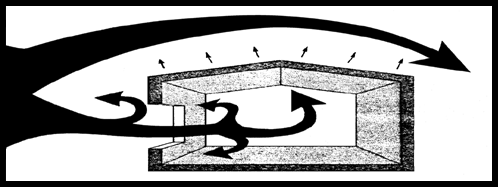
Internal pressurization occurs when wind enters, such as through a broken window, and literally pushes the building apart from the inside, as shown in Figure 1 below. Typically, buildings are designed to withstand wind from the outside, so when the wind enters, its components become overloaded often resulting in the loss of roofs. This leads to water infiltration and even the collapse of structures.
| Figure 1 |
 |
Risk control measures to help protect the envelope of the building include:
1. Installing storm/hurricane shutters
2. Replacing ordinary window glass with laminated, impact resistant glass
3. Covering windows with plywood
4. Installing film coatings specifically designed for improving impact resistance
5. When replacing roofs, upgrade to wind resistive roof coverings
6. Minimize sources of wind-borne debris and flying missiles by bringing outdoor items such as patio furniture, trash cans, flowerpots, and pieces of lumber indoors
7. Prune trees and remove loose limbs before the storm season
8. Avoid planting trees close to the building
Keep Out Water
A high volume of rain often accompanies violent windstorms. Because of the huge amount of rain, water can build up quickly and cause roof collapse. If the interior of the building becomes exposed, the loss to you and your recovery time is greatly increased.
Buildings with flat roofs and walls that extend above the roof level (a.k.a. parapets) are particularly vulnerable to roof collapse due to accumulated water. If the roof drain and/or gutter system is clogged or inadequate, the weight of pooling water will eventually collapse the roof truss system.
Rising water from a blocked storm drain presents another problem. Inspections for this condition may need to be increased during the time of year when leaves fall and/or depending on whether nearby trees are evergreen or deciduous. Because getting onto the roof and knowing what to look for can require special knowledge or equipment, one good risk control strategy is to have a licensed professional evaluate the roof, gutters, and drains.
Building Contents
• When hurricanes approach, move everything away from exterior walls and into a more
central secured area of the building. A secured area could be an interior room or hall.
Accepted good practice for storage of stock, supplies, and other materials is to keep them
off the floor. Store them on shelves, pallets, etc. This practice will also serve you well during
the storm season. Cover all computers and office equipment with plastic/polyethylene.
Businesses with perishable items should do at least one of the following:
• Make provisions for an alternative power source
• Rent a portable power generator
• Lease a refrigerated semi-truck trailer
• Arrange with another company to temporarily store perishable products
Additional suggestions to protect business, property, and people from a windstorm can be found in the Windstorm Checklist (Appendix E7). The Institute for Business and Home Safety's (IBHS) website is a valuable source of information for help with developing your disaster preparedness plan.
Review your disaster preparedness plan with your management staff and remember that getting prepared early is the key to minimizing your loss. Some additional items to have in your plan include:
• Reviewing your communications and recovery plan with your staff annually before the storm
season - have a drill
• Having your business appraised at least every five years
• Inventory, document and photograph the equipment, supplies, and the entire workplace
• Having copies of your insurance policies and customer service/home numbers in a
safe place
• Obtaining business interruption coverage
Remember that flood damage requires separate coverage and is NOT covered under any other insurance policies.
Fire Protection
Portable Fire Extinguishers
To ensure that fire extinguishers are helpful to you, this section provides essential information about:
• Classification of Fires and Rating Fire Extinguishers
• Selection and Placement of Fire Extinguishers
• Training of Employees
• General Tips
Classification of Fires and Rating Fire Extinguishers
Fire extinguisher manufacturers use a letter to designate which class or type of fire an extinguishing agent will suppress. In conjunction with the classification, they also use a numerical rating (i.e. 2-A:20-B) to designate relative extinguishing effectiveness or size of a fire that can be extinguished.
Class "A" - Ordinary combustible materials (i.e. wood, paper, cloth, rubber, etc.)
Class "B" - Flammable and combustible liquids and gases (i.e. gasoline, propane,
solvents, etc.)
Class "C" - Energized electrical equipment
Class "D" - Combustible metals (i.e. magnesium, lithium, sodium, titanium, etc.)
Class "K" - Cooking media (oils and fats)
Extinguishers which are effective on more than one class of fire have multiple letter and numeral-letter classification for example, an extinguisher rated and classified, 4-A: 20-B:C indicates the following:
1. For Class "A" fires, it should extinguish approximately twice as much fire as a 2-A extinguisher.
2. For Class "B" fires, it should extinguish approximately 20 times as much as a 1-B extinguisher.
3. "C" indicates that it is suitable for use on energized electrical equipment.
Selection and Placement of Fire Extinguishers
Selecting the proper extinguishers requires careful consideration with regard to both the class and type of fire and the hazard of occupancy for which they are used. The hazard of occupancy is graded as (1) light or low, (2) ordinary or moderate, or (3) extra hazard. It takes into consideration the amount of combustibles or flammable liquids present.
For class "A" fires, the larger the area to be protected, the larger the numerical rating required. The minimal size fire extinguisher is 2A, which is designed to handle up to 3000 square feet of light class "A" hazard. The maximum travel distance to the closest fire extinguisher can be no more than 75 feet.
For class "B" fires, a minimal size 5B extinguisher, located within 30 feet of the fire hazard, is allowed for protecting light hazards. For ordinary hazards, National Fire Protection Association (NFPA), National Fire Code, NFPA 10*, Standard for Portable Fire Extinguishers requires at least a 10B extinguisher and for an extra hazard a 40B is required. For additional information on sizing and distribution, refer to National Fire Protection Association, NFPA 10* and the FCCI Risk Control Bulletin, Fire Extinguishers.
For class "C" extinguishers, which are intended for use on energized electrical equipment or wires, the size and placement is based on the class "A" and "B" hazards present. Typically class "C" fires become either Class "A" or "B" after the electrical line has been de-energized. The Class "C" extinguishing agent is designed to protect the user from electrical shock
Class "D" extinguishers are specifically designed for fires involving combustible metals such as lithium, magnesium, potassium, sodium, titanium, and zirconium.
Class "K" extinguishers are for the protection of cooking appliances that use combustible cooking grease (animal fat) and vegetable oil. Class K extinguishers have no numerical rating. However, they come in at least two sizes, a 6.0 liter (1.6 gallons) and a 9.4 liter (2 and 1/2 gallons) size. Consult with your fire extinguisher service company to select the size appropriate for your needs. The maximum travel distance to a Class "K" portable fire extinguisher is 30 feet.
For each class of fire, the number and size of extinguishers needed can depend on the level of the hazard, the number of square feet being protected, the distance you must travel to get to the extinguisher, the degree of difficulty to get to the extinguisher, and how many different classes of fire hazard are present. Further details on size and placement can be found in the National Fire Code, NFPA 10* and also refer to the FCCI Risk Control Bulletin, Fire Extinguishers found in the Property Additional Resource List (Appendix E10).
Training of Employees
The most important point to emphasize when training employees in the use of fire extinguishers is that someone must report the fire immediately, by calling 911. Do not delay. All too often well-intentioned employees try to extinguish a fire without notifying the fire department. Frequently the end result is a fire that gets out of control, causing major damage. The local fire department, the fire extinguisher distributor, the fire extinguisher manufacturer, and some consultants can provide useful hands-on training for employees. At the very least they should be able to provide you with a video.
Until you have scheduled formal training you can teach your employees how to help control small fires. An easy-to-remember acronym, PASS, describes how to use a portable fire extinguisher. The letters in the word PASS
stand for:
P - pull the locking pin that keeps the trigger from accidentally being activated
A - approach to within 6-8 feet of the fire and aim the nozzle at the base of the fire (not at the
flames)
S - squeeze the trigger to dispense the extinguishing agent
S - sweep the extinguishing agent back and forth across the base of the fire (to cover as
much of the fire area as possible)
General Tips
• Periodically re-evaluate the fire exposure and the number, class, and size of extinguishers
needed and available.
• Hang the extinguisher via a bracket attached to a permanent structure, in a readily
accessible and conspicuous location. Good locations include those close to and along
the aisleway to the exit.
• Do not block or cover the fire extinguisher. It is not a coat rack.
• The area supervisor should inspect the extinguishers weekly for accessibility and to confirm
that they are charged and ready for use.
• Replace discharged or damaged extinguishers as soon as possible.
• Place location signs higher on the wall to be more conspicuous.
• Have the correct type of extinguisher available for use outside the building should there be
a known or anticipated external hazard.
• Have a licensed fire extinguisher company service all the extinguishers at least annually.
* You can purchase a copy of this code through the NFPA website or contact your Loss Control Representaive for other options.
Automatic Sprinkler Systems
Purpose & Description
For fire protection purposes, the National Fire Protection Association essentially defines an automatic sprinkler system as an integrated system of underground and overhead piping, designed in accordance with fire protection engineering standards, usually activated by heat from a fire and discharging water over the fire area.
When a properly designed and maintained sprinkler system protects your property, it is almost like having a firefighter with a hose on duty 24 hours a day, ready to suppress a fire should one occur. While sprinkler systems are primarily designed to control fires until the fire department arrives to extinguish them, it's common for these systems to extinguish a fire. Having the system provided with a central station water flow alarm also helps assure that the fire department will arrive promptly.
To protect business, property, and people from serious fire loss or injury, sprinkler systems are probably the best investment a business owner can make. Benefits can include:
• Dramatically minimizing potential loss of life in a fire
• Reducing the average loss per fire by one-half to two-thirds
• Reducing business interruption losses and uninsured losses
• Substantially increasing the probability that a business can survive a fire loss
• Substantially reducing property insurance premium and amortizing the cost of the system
over the life of the building
• Reducing legal liability potential arising from fire in your property causing damage to
neighboring businesses
• Greater peace of mind
Reliability
Automatic sprinkler systems are widely regarded by fire protection specialists as the most reliable and effective fire protection devices today. Studies in occupancies where inspection, testing and maintenance were rigorous have shown reliability performance of 99.5%. This means that in 99.5% of the incidents studied, the sprinkler system operated when needed and also controlled or extinguished the fire.
While there are some studies published that show reliability estimates as low as 81.3% and 87.6%, they appear to reflect biases in the databases. The number of incidents evaluated in both studies were relatively small and apparently other types of fire suppression systems were included, i.e. not just sprinkler systems.
On average, sprinkler systems have controlled or extinguished more than 90% of the fires in which they have functioned. The National Fire Protection Association estimates that when they do fail, it is because of the following reasons: 1) closed valves - 35%, 2) not designed for occupancy - 14%, 3) inadequate water supply - 10 %, 4) only partial sprinkler protection-8%, 5) obstructions to water flow - 8%, 6) inadequate maintenance and testing - 8%, 7) construction- 6%, and 8) all other causes - 11%.
Types of Systems
Wet pipe systems: are the most common, probably accounting for 85% of all systems in place today. They are also the simplest, and most reliable type of system with their simplicity being a key to their reliability. The pipes are filled with water. Heat from a fire causes a sprinkler head to open, discharging water on the fire either extinguishing it or keeping it from spreading too quickly before the fire department arrives to extinguish it.
Dry pipe systems: are the second most common accounting for an estimated 10 to 13% of systems in place today. They are more complicated than wet pipe systems, less reliable, less effective overall, more difficult to maintain, and more expensive to install. However, since water freezes they are a necessary alternative to wet pipe systems for unheated buildings in colder climates or in occupancies such as cold storage warehouses.
Dry pipe systems have air or nitrogen gas in the pipes. Heat from a fire causes a sprinkler head to open which allows the air or nitrogen to discharge as the water fills the pipe and then discharge on the fire through the open head(s).Because the water is delayed in reaching the fire, resulting fire damage is typically greater than with a wet pipe system. After activation the system needs to be drained and reset.
Pre-action systems: are designed for properties that are highly susceptible to water damage, such as libraries, art galleries and computer rooms. Two things must happen before water discharges. First, a fire detection system detects a fire, sounding an alarm and opening a valve that allows water to flow into the sprinkler piping. Heat from the fire then causes a sprinkler head to open, discharging water on the fire. This two step operation reduces the possibility of accidental water discharge that might result from accidental damage to sprinkler piping or a sprinkler head.
Deluge systems: are the only type of sprinkler system designed with open sprinkler heads and are used in extra hazardous occupancies such as aircraft hangers, electrical transformers, and high volume flammable liquid/flammable gas storage where large volumes of water must be discharged on a fire very quickly. All sprinkler heads in the system are open, a smoke/heat detection system detects a fire, opens a valve and water fills the sprinkler piping, discharging from all sprinkler heads. The valve must be reset after activation and these systems are very complex and expensive to install and maintain. However the value of properties they protect are typically high.
Tips on System Maintenance, Inspection and Supervision
Whether you occupy your own building or are a tenant in another's building , you have a vested interest in assuring that the sprinkler system will control a fire, should one occur despite your best efforts to prevent one. In general, maintenance, inspection and supervision should be in accord with provisions of the latest edition of the National Fire Protection Associations Standard NFPA 25*, Standard for the Inspection, Testing, and Maintenance of Water-Based Fire Protection Systems. Following is a list of good practices that will help insure that the fire protection sprinkler system provides peace of mind when protecting business, property, and people:
• Have a licensed sprinkler contractor evaluate the automatic sprinkler system to be sure it is
suitable for the hazards that exist in your business. Sprinkler system designs are based on
hazards of occupancy and fire loading related to types and configurations of storage. If any
of these conditions change, you need to know that the system design is still adequate.
• Have water flow and valve closure supervised and monitored by a central station.
• Have testing and inspection of your automatic sprinkler system performed by a competent
sprinkler service company at least on a semi-annual basis to ensure it stays in good
operating condition to include at least:
a) A main drain flow test with record of static and residual pressure to be sure there are
no significant obstructions to water supply such as closed valves or blockage in the
water main.
b) An alarm test to be sure that operation of one sprinkler head is sufficient to operate the
local water flow alarm.
c) A test to insure that an alarm signal is received by the central station when initiated by
water flow and valve closure.
d) An overall inspection of system condition including, piping, valves, hangers, fire
department connections, and sprinkler heads, etc., to be sure system is in good
general operating condition.
e) Refer to Sample Wetpipe Sprinkler System Inspection (Appendix E8), for a
sample form that will help provide you with additional information and ideas for
developing an inspection format that meets your specific needs.
* You can purchase a copy of this code through the NFPA website or contact your Loss Control Representaive for other options.
|
|
|
|
|
|



